Research on AI and schedule overrun
Can a model trained on basic project data warn us that a schedule will slip, and which model does it best? My co-authors and I published two papers on these questions in 2026.
Benchmarking Machine Learning Models for Software Project Schedule Overrun Prediction
The question. If machine learning can predict schedule overrun, which algorithm gives the best balance of accuracy and interpretability?
Method. We compared six regression algorithms on 4,517 software-project records: linear regression, regression tree, random forest, support vector regression, gradient boosting machine and a deep neural network. All used the same predictors, default settings and 10-fold cross-validation.
Findings. Gradient boosting had the lowest errors. The deep neural network came very close and had the highest squared correlation. Random forest ranked third, and support vector regression was weakest under default settings. Risk factor, duration and client satisfaction were again the most consistent predictors. Weighing accuracy and interpretability together, gradient boosting is the strongest practical choice for early-warning systems and portfolio decisions.
Sweilem, A. R., Abdoh, H. J., & Abdoh, A. J. (2026). Benchmarking Machine Learning Models for Software Project Schedule Overrun Prediction. Journal of Computer Science and Technology Studies, 8(8), 159–212. https://doi.org/10.32996/jcsts.2026.8.8.13
AI-Based Schedule Overrun Prediction in Technical Projects Using Gradient Boosting Machine for Decision Support
The question. Traditional project control relies on expert judgment and static plans, which makes schedule performance hard to predict as technical projects grow more complex.
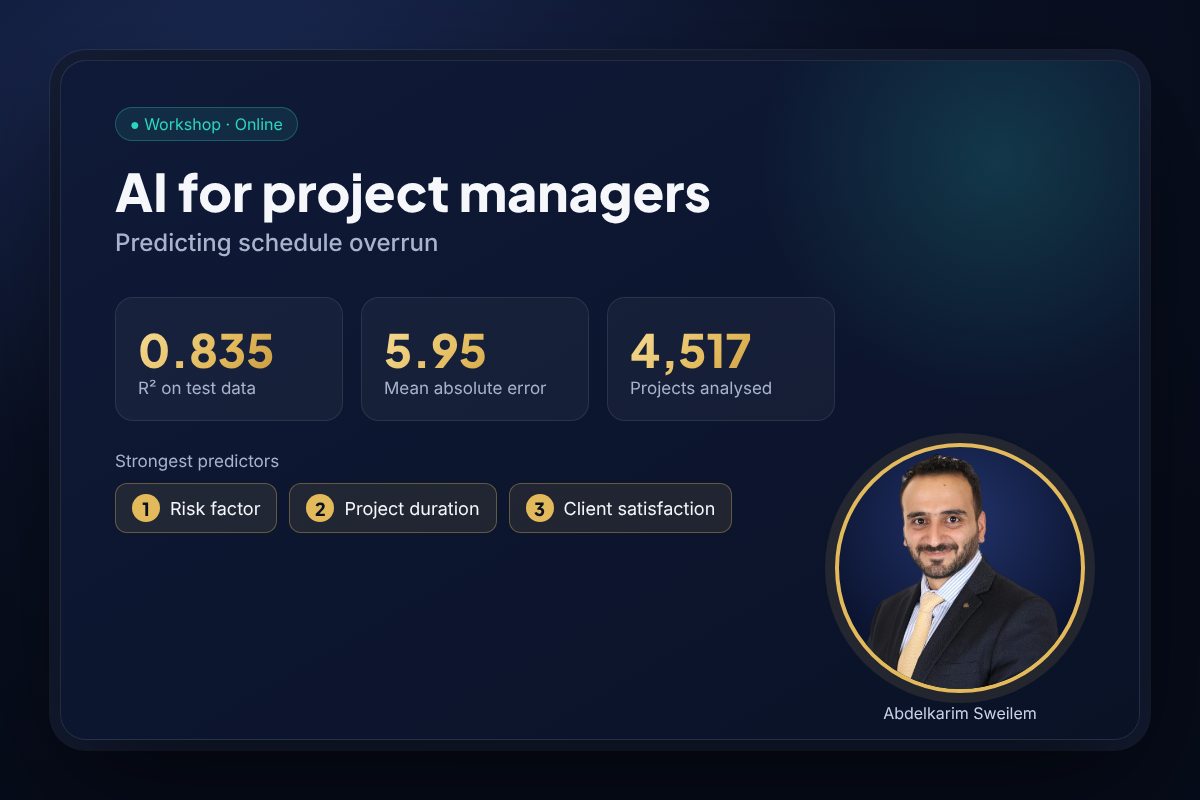
Method. We trained a gradient boosting machine on a public dataset of 4,517 projects. Inputs were duration, total cost, team size, risk factor and client satisfaction; the target was schedule overrun as a percentage.
Findings. The model explained about 83.5% of the variation in overrun. Risk factor and project duration were the most influential predictors, followed by client satisfaction.
Sweilem, A. R., Abdoh, H. J., & Abdoh, A. J. (2026). AI-Based Schedule Overrun Prediction in Technical Projects Using Gradient Boosting Machine for Decision Support. Frontiers in Computer Science and Artificial Intelligence, 5(8), 01–16. https://doi.org/10.32996/jcsts.2026.5.8.1
Plain-language summaries for practitioners: What 4,517 projects tell us about schedule overrun and Six models, one question.
Predicting schedule overrun before it happens
Two papers published in 2026. The first trains a gradient boosting model on 4,517 projects to estimate how far a schedule will slip. The second benchmarks six machine learning models on the same question. Risk factor and planned duration are the strongest signals.
Have a program to deliver or an exam to pass?
Tell me what you're working on. I reply within two working days, in Arabic or English.